-e1679996194676.png)



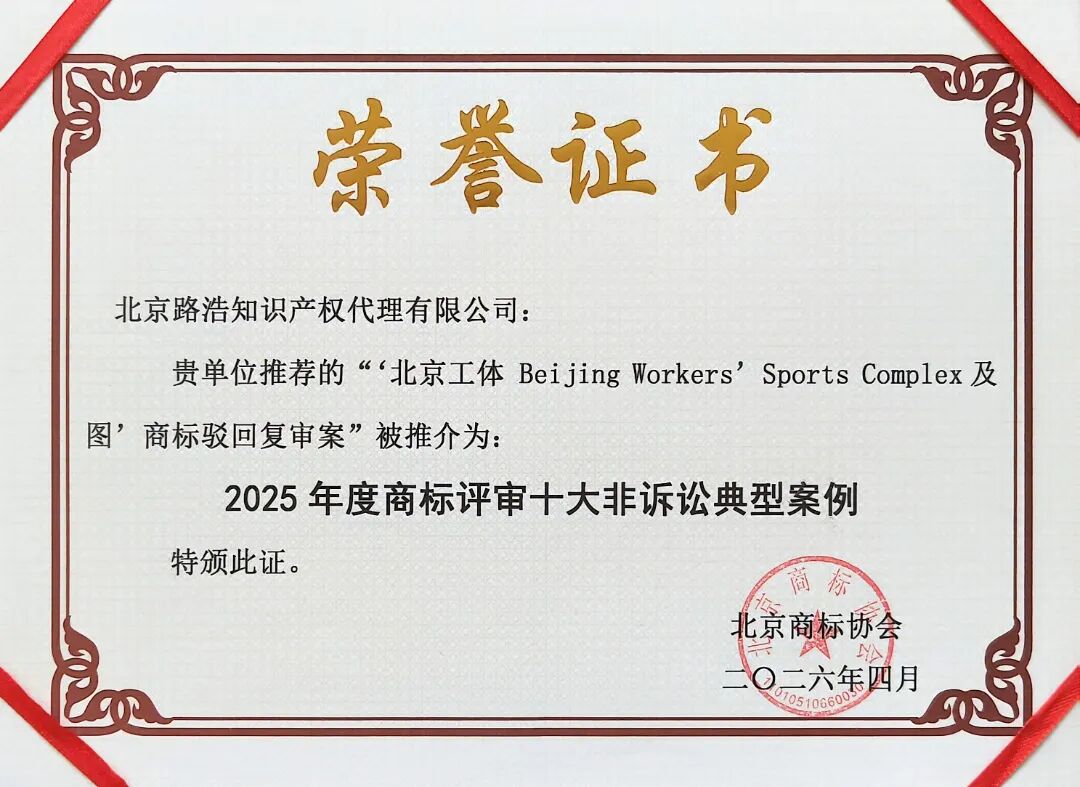
On April 18, 2026, the Beijing Trademark Association held the Press Conference on the Release of the Top 10 Litigious and Top 10 Non-Litigious Trademark Cases of 2025. The case handled by CN-KnowHow IP Group —namely, the Rejection Review of the Trademark “Beijing Workers’ Sports Complex” (Chinese: 北京工体) and Logo—was selected as one of the Top 10 Non-Litigious Trademark Review Cases of 2025, reflecting the firm’s sustained excellence in trademark practice.
This marks CN-KnowHow IP Group’s consecutive recognition in this prestigious annual selection, further underscoring its profound expertise and outstanding practical capabilities in trademark authorization, confirmation, and administrative proceedings.
Case Summary
In July 2024, the Beijing Workers’ Sports Center (hereinafter “Applicant”) filed an application to register the trademark “Beijing Workers’ Sports Complex” (Chinese: 北京工体) and Logo in Class 41 (services). The China Trademark Office rejected the application, citing violation of Article 10(1)(7) of the Trademark Law of the P.R.C.—i.e., the mark is likely to cause the public to mistake the origin or other characteristics of the services.
Upon being retained, CN-KnowHow IP Group, adhering strictly to the legislative intent of Article 10(1)(7), advanced two core arguments:
First, geographical alignment negates deceptive potential. The Applicant’s registered domicile is Beijing itself—directly contradicting the scenario targeted by the Trademark Examination and Review Guidelines, namely, where a mark contains a geographical name but the applicant is not from that location, thereby misleading the public. Here, the alignment eliminates the very premise of deception.
Second, the abbreviation has acquired distinctiveness and unambiguous association. “Beijing Gongti” (北京工体) is a long-established, conventional abbreviation used by the Applicant and its affiliates. CN-KnowHow IP Group submitted comprehensive evidence, including:
- 17 related trademark registrations filed by the Applicant since 2006 covering “Gongti” (工体) and the contested logo;
- over 40,000 media reports (2004–2023) referencing “Gongti”;
- the award of “Beijing Well-Known Trademark 2023” to “Gongti”;
- documentation of the Applicant’s hosting of numerous top-tier sports and cultural events;
- official confirmation letters from the superior authority and trademark licensing agreements with affiliated entities.
Collectively, this evidence demonstrates that, through decades of continuous use and extensive promotion, “Beijing Gongti” has developed a unique, stable, and publicly recognized association with the Applicant—fulfilling the essential function of source identification and eliminating any likelihood of confusion.
In July 2025, the Trademark Review and Adjudication Board (TRAB) accepted CN-KnowHow IP Group’s arguments, and issued a decision to grant preliminary approval of the contested trademark.
Significance of the Case
This landmark victory holds significant reference value and guiding implications for the examination and registration of trademarks comprising geographical names and entity abbreviations:
First, clarifying the examination principle: The case rectifies the mechanistic view that “a trademark containing a geographical name is inherently misleading.” Examiners must first assess whether the applicant’s domicile aligns with the geographical name; if so, the risk of source deception is fundamentally negated.
Second, establishing evidentiary standards: Where a trademark is based on an entity’s abbreviated name, the applicant must prove—through long-term, widespread use and publicity—that the abbreviation has acquired a uniquely identifiable association with the applicant in the marketplace, thereby fulfilling the distinctiveness requirement.
Third, underscoring evidence preservation: The case powerfully illustrates that systematic brand evidence accumulation is pivotal. A cohesive evidentiary chain—comprising prior registrations, sustained publicity, official recognitions, and major event documentation—is the cornerstone of success in such proceedings.
Fourth, delivering practical guidance: The case sets a clear precedent for legal defense strategies and evidence structuring in similar rejection review cases involving corporate abbreviations and geographical elements.
Key Takeaways from Case Handling
CN-KnowHow IP Group’s legal team emphasized that the case’s success hinged on three pillars: precise issue framing, professional legal reasoning, and exhaustive evidentiary support:
· Precise issue framing: Focusing squarely on the intent of Article 10(1)(7), the team directly challenged the “likelihood of confusion” element—avoiding generic arguments and targeting the core legal threshold.
· Professional legal application: By deeply interpreting the underlying logic of geographical-name trademark examination rules in the Guidelines, the team convincingly argued that the factual scenario herein falls outside the scope of conduct the law seeks to prohibit.
· Building an evidentiary fortress: The team comprehensively compiled and integrated decades-long brand-building evidence—including trademark portfolios, media coverage, official awards, and event records—forming an irrefutable chain that robustly proved the unique association and strong recognition of “Beijing Gongti” with the Applicant.
The successful resolution of this case reaffirms that in trademark authorization and confirmation matters, a deep grasp of legal principles, precise construction of legal arguments, and rigorous evidence preparation are the fundamental safeguards for client rights. CN-KnowHow IP Group remains committed to delivering professional, rigorous, and efficient services to protect and advance our clients’ trademark rights—today and in the future.